The Best Indonesian Music | A Top 12

If you look at the countries along maritime trade routes, you can notice many interesting things. Today, my interest is cultural exchange. And countries like Indonesia, Malaysia, Sri Lanka, and coastal India are great examples.

Having coastal borders means traders, migrants, and empires that moved through the Indian Ocean left cultural impact. 

This is especially true of Indonesia because it lies between the Indian and Pacific Oceans. So its coastal communities and ports have been a great influence on Indonesian music. 

You can also trace its influence on Indonesian music instruments, performance traditions, and genres. Similarly, Dutch colonial rule also brought European musical influence.

That history pretty much explains Indonesian music. Now, I will pick some music genres, trace their history and talk about famous Indonesian singers.

I. Dangdut

Indonesian music

Dangdut is a popular Indonesian music for dancing that combines local music, Malay orchestras, Indian and Malaysian film musics, and Western rock. The style became popular in Jakarta in the late 1960s as the urban youth wanted modern music.

Rhoma Irama was a pioneering singer of the genre. He improvised the dangdut sound by adding synthesizers, drum set, electric guitars, and bass while keeping the dang-dut rhythm.

Since Rhoma Irama also changed lyrics from romance to subtle teachings of Islam, the genre was quite popular in the lower and middle class Indonesian Muslims.

But now, the music remains popular in its lighter form in dance clubs and parties.

1. Rhoma Irama

Rhoma Irama’s rise coincided with Dangdut as a commercial genre in the 1970s. After performing with several Orkes Melayu groups in the 1960s, he formed Soneta Group in 1970.

With the band, he produced hit Indonesian music albums like Begadang, Penasaran, Rupiah, and Darah Muda. 

He also brought his band Soneta into cinema, where he starred in films and his band scored the music for those movies. 

Oma Irama Penasaran, Gitar Tua, Darah Muda, Begadang, and Raja Dangdut are some of his top Indonesian movies. 

He was also involved in politics. And rightly, by the end of the decade, Indonesian music fans gave him the title “Raja Dangdut.”

II. Kroncong

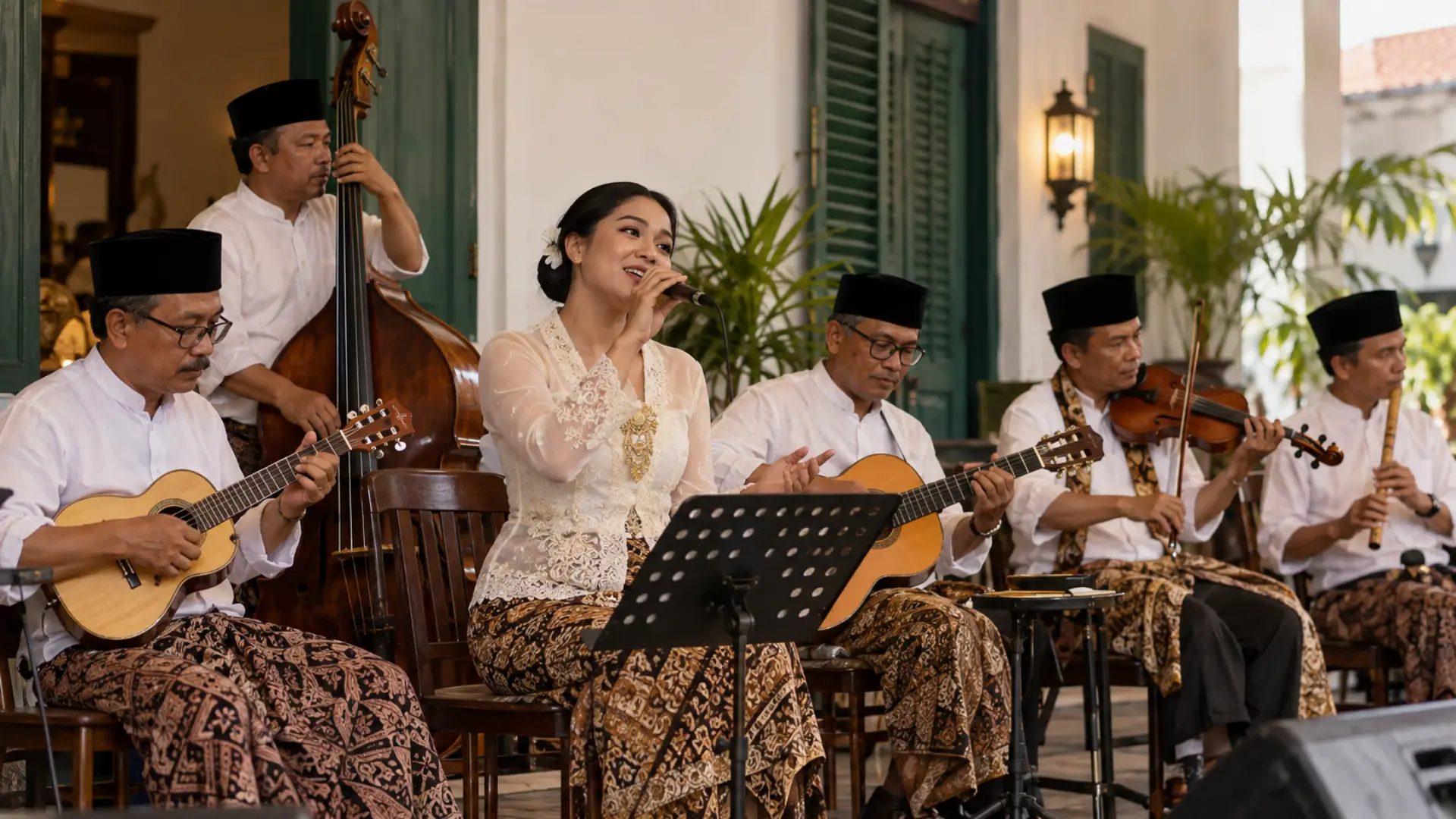
Kroncong is the oldest music from Indonesia with Portuguese influence from the 16th century. It all began when Portuguese settlers and freed people came to Kampung Tugu in North Jakarta. 

By the 17th century, Krontjong Toegoe, an earlier form has Portuguese cavaquinho, and later ukulele, guitar, violin, flute, cello, and bass.

Over time, Indonesian musicians adopted the Kroncong to local musical practices. During the 20th century, it spread from Batavia and became part of Indonesia’s traditional repertoire.

2. Gesang Martohartono

Gesang Martohartono was a kroncong singer and songwriter from Surakarta. Initially, he began performing with local kroncong groups in the 1930s. Although, a self-taught musician, yet he gave some of the best kroncong compositions like “Si Piatu,” “Roda Dunia,” and “Sapu Tangan”.

His defining work came in 1940, when as a 23-year-old, he composed “Bengawan Solo” in the kroncong style. And he took inspiration from the Bengawan Solo River near his hometown. 

The song eventually became an international standard, particularly in Japan, where it was recorded after World War II. Its success made Gesang the Indonesian singers of the Surakarta kroncong music.

III. Folk and Protest Songwriting

Indonesian music

Folk and protest songwriting is an important part of Indonesian music history because of the New Order period (1967–1998) under President Suharto. Because of government censorship, some Indonesian musicians used songs to address poverty and political repression. 

The tradition drew from Indonesia’s folk songwriting culture. So, rather than musical arrangements, many Indonesian protest songs were straightforward melodies.

By the 1980s, socially critical songwriting was a key part of popular Indonesian music. This became more intense when economic problems and political tensions multiplied. 

By the late 1990s, several protest songs were popular in opposition to Suharto, contributing to his resignation in 1998.

Iwan Fals, Ebiet G. Ade, Franky Sahilatua, and Gombloh are some of the top indonesian musicians of protest song writing.

3. Iwan Fals

Iwan Fals remains one of the top Indinesian singers who wrote songs about social and political problems. His song “Surat Buat Wakil Rakyat” which criticized members of parliament, became a popular song at student demonstrations. 

In 1989, Iwan Fals joined Swami, whose album Swami I included “Bento” and “Bongkar.” “Bento” is about a wealthy and corrupt elite figure, while “Bongkar” became an anthem of protest. 

His public performances made him one of the famous singers of Indonesia’s protest music. In 2000, Time magazine included him in its “Asian Heroes” feature.

IV. Pop and Rock

Indonesian music

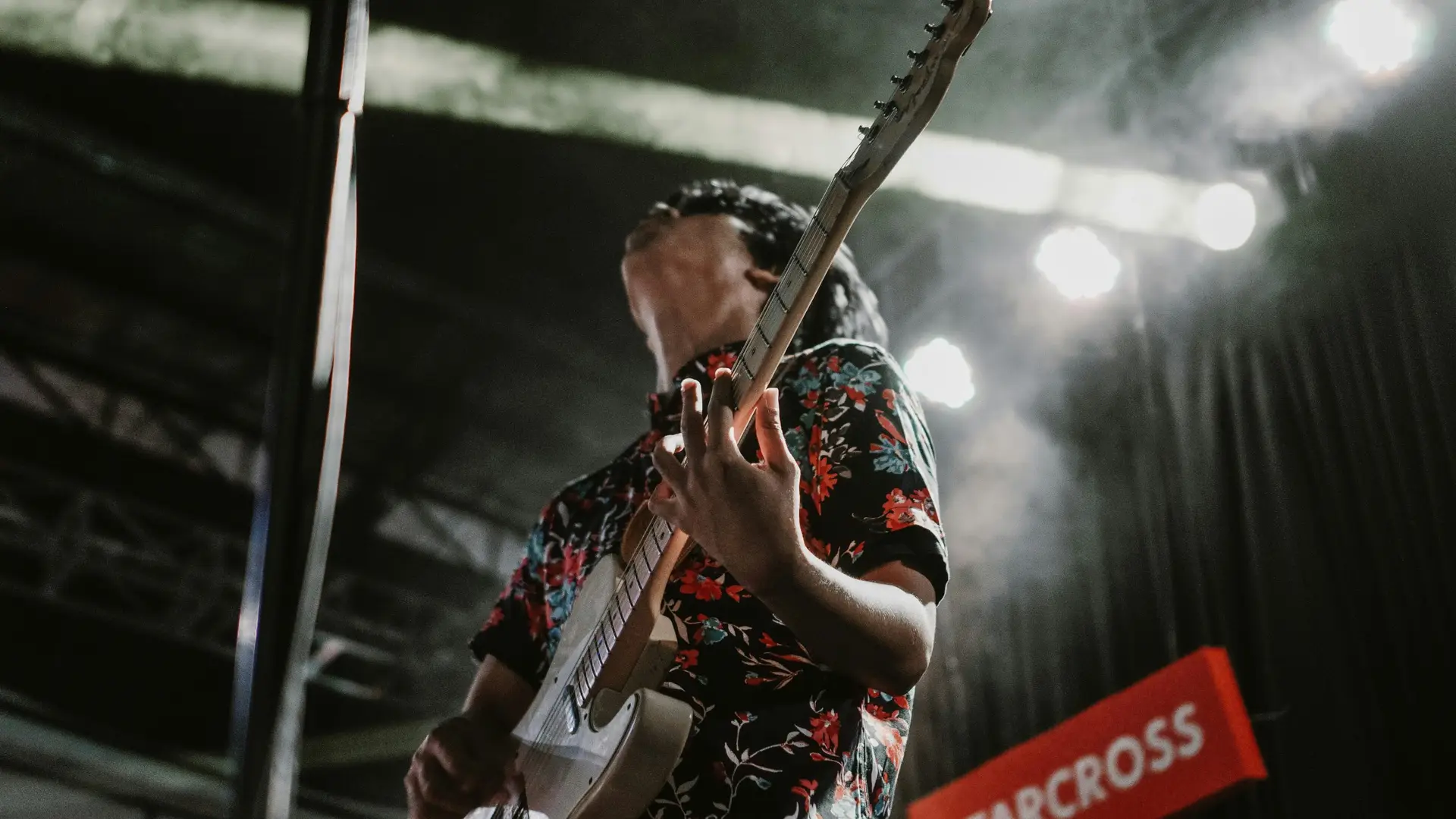
Although Indonesian pop music had a presence well before the 1960s, rock became popular later, during the 1970s. And that too because of when Western pop and rock music came to Indonesia through radio, records, films, and touring musicians.

The 1970s were a popular time for pop when Chrisye, a progressive pop singer, gave pop music a sound beyond commercial songs. His album, Guruh Gipsy, remains one of the top Indonesian  music works combining Western rock with local musical traditions.

Indonesian rock music has a different story though. During the 1970s, bands like God Bless, Gipsy, Giant Step, and AKA brought progressive, hard-rock, drew heavily from progressive rock and hard rock. 

A younger Indonesian musicians like, Dewa 19, Sheila on 7, and Padi,  by the late 1990s and early 2000s, were playing pop-rock. Dewa 19 was quite instrumental in making pop-rock one of the top sounds of Indonesian music.

4. Chrisye

Chrisye began his professional career in the late 1960s as the bassist of Sabda Nada. Initially, the band used to cover British and American rock songs. 

Later, in the 1970s, Gipsy went to America and used to play at the Ramayana Restaurant. This experience gave Chrisye a strong grounding in the rock arrangements that would influence his work in Indonesia.

After returning to Indonesia, Chrisye recorded an album, Guruh Gipsy, in 1976. The album was a progressive-rock with Javanese and Balinese music. The album remains one of his best Indonesian music albums for a fusion of Western rock.

Chrisye went on to release more than 30 albums during his career. He won several BASF Awards, including the Lifetime Achievement Award. In 1998, his album Kala Cinta Menggoda won nine AMI Awards.

Want to explore more rock? Check out exciting the Latin rock bands.

5. Dewa 19

Dewa 19 in an Indonesian rock band by the four students. The group initially played pop and later experimented with jazz before developing the pop-rock. Their debut album, Dewa 19, won the BASF Award for Best-Selling Pop Album in 1993. 

Their later Indonesian rock albums such as Format Masa Depan, Terbaik-Terbaik, and Pandawa Lima, took a progessive approach to pop-rock. 

The bands’ combining of rock with pop melodies and, particularly Terbaik-Terbaik, jazz, funk, folk, makes their music quite unique. 

Overall, they released eight studio albums, with the album, Bintang Lima, selling more than 1.7 million copies in Indonesia. 

Although 2 founding members have passed away, the band is still active and one of the pioneers of Indonesia music.

6. Sheila on 7

Sheila on 7 is also the product of 1990s pop-rock scene. The band’s rise began when it signed with Sony Music Entertainment Indonesia and released its self-titled debut album in 1999. 

The combination of jangly guitar, rock, and Indonesian-language songwriting made their album a commercial hit. It went on to sell around 1.3 million copies.

Their second album, Kisah Klasik Untuk Masa Depan, had hit songs like “Sephia,” “Sahabat Sejati,” and “Bila Kau Tak Di Sampingmu”, while selling around 1.7 million copies. 

This was also the album that was hit in Malaysia and Singapore. Even their third album, 07 Des, sold more than one million copies. It is the only Indonesian band to have its first three albums, selling one million copies each.

V. Contemporary Pop and R&B

Indonesian music

Indonesian pop and R&B music starts from the 2000s onward. Since the music production was more accessible, Indonesian singers had plenty to experiment with R&B, soul, jazz, funk using electronic production. 

So from that time onwards, Indonesian music is more polished studio production, with singers like Tulus, Raisa, Glenn Fredly, and Maliq & D’Essentials taking the lead.

Maliq & D’Essentials were particularly popular for mixing R&B, soul, jazz, and funk. Their debut album, 1st, was a mainstream success. 

During the 2010s and 2020s, contemporary Indonesian pop became much more personal with distinct vocal identities. Yura Yunita’s album, Tutur Batin, for example, explores self-acceptance and relationships.

A new generation of Indonesian singers, including Tulus, Raisa, Isyana Sarasvati, Yura Yunita, Nadin Amizah, Hindia, and Salma Salsabil are more experimental and expressive.

7. Maliq & D'Essentials

Maliq & D’Essentials is an Indonesian jazz and soul music band active since 2002. It was a product of Jakarta’s club and jazz scene with a sound around R&B, soul, jazz, funk, and neo-soul. As I wrote above, their first album, 1st, was a commercial success. 

What makes Maliq & D’Essentials unique is their jazz-influenced chords, layered keyboards, and soulful vocals. Free Your Mind, their second album, won the Best Jazz Album award at the 2008 Anugerah Musik Indonesia. 

So far, Maliq & D’Essentials have released elevent albums, with Can Machines Fall in Love? Being their most recent studio album. 

Since we are talking about jazz albums, here are some of the best jazz albums to check.

8. Yura Yunita

Yura Yunita is one of the top Indonesian female singers. She mixes pop with soul, jazz, and R&B influences. Her first hit song “Cinta dan Rahasia,” was a collaboration with Glenn Fredly. 

Her first album, Yura, had hit songs like “Berawal Dari Tatap” and “Cinta dan Rahasia”.

Her second album, Merakit, was a diverse mix of pop, R&B, and soul. It also had  collaborations with Reza Artamevia and Glenn Fredly. Her third album, Tutur Batin, came out in 2021.

She has won the Best Female Pop Solo Artist four times at the Anugerah Musik Indonesia Awards.

9. Andmesh

Andmesh Kamaleng is one of the leading Indonesian male pop singers of the 2010s and 2020s. He won the second season of Rising Star Indonesia in 2017, a starting of his professional singing. His breakthrough song “Cinta Luar Biasa” was a major hit across Indonesia and Malaysia.

Since then, many of his singles have reached No. 1 on the Indonesian Billboard charts. His first album, Cinta Luar Biasa, came in 2019. He followed it with the second album, Cinta & Doa, in 2023.

He has won four Anugerah Musik Indonesia Awards, including the Best Pop Album for Cinta Luar Biasa in 2020.

10. Salma Salsabil

Salma Salsabil is one of the new singers of Indonesian pop music. She came to limelight after winning the 12th season of Indonesian Idol in 2023. 

Her first major release was “Menghargai Kata Rindu,” a popular Indonesian pop song.

However, it was her second single “Bunga Hati,” which won four awards at the 2024 Anugerah Musik Indonesia Awards, including Best Female Pop Solo Artist. 

She released her first album, Berharap Pada Timur, came in 2025, following successful singles. Overall, she remains one of the promising Indonesian singers of contemporary pop.

VI. Electronic and Dance

Electronic dance music was already present in Indonesian nightclubs during the 1990s, but it has a unique form, Funkot, short for Funky Kota. It is a mix of House music with a fast tempo of 160 to 220 bpm. Barakatak were the pioneers of Funkot, as they took the genre across Asia, especially Japan.

The EDM scene further rose during the 2000s. Jakarta Movement 2004 and Jakarta Movement 2005 were one of the biggest rave events of dance music.

Later, Djakarta Warehouse Project (DWP) went from club-level event to large outdoor event and its 2026 edition will happen from December 11 to 13. 

International musicians like Tiësto, David Guetta, Swedish House Mafia, and DJ Snake have performed at the Djakarta Warehouse Project.

11. Weird Genius

Weird Genius is an Indonesian electronic music group from Jakarta. “DPS,” “Sweet Scar,” “WKWK Land,” “Irukandji,” and “Last Dance,” are some of their early hit songs. 

But it was “Lathi,” featuring Sara Fajira, which became an international hit. It was No. 2 on Spotify’s Global Viral 50. 

Weird Genius has released a large number of singles and collaborations but does not have a studio-album so far. Despite this, they have won three Anugerah Musik Indonesia Awards.

12. Bottlesmoker

Bottlesmoker is an Indonesian electronic duo from Bandung. They began making electronic music in the mid-2000s, when indietronic music was still uncommon in Indonesia.

Their earliest albums like, Before Circus Over, and Slow Mo Smile were quite eletric. But later, they started mixing electronic music with Indonesian and Southeast Asian music.

Even more interesting is their album, Parakosmos, which also includes field recordings of Indonesian traditional music into electronic compositions.

With multiple albums to their credit, they are a regular feature of music festivals and rave parties.

Indonesian Music | A Recap

Indonesian music

Some time ago, I wrote about the Jalanan, one of the best music documentaries, by the filmmaker, Daniel Ziv. 

The documentary is about three Jakarta street musicians, Boni, Ho, and Titi, as they make a living performing on crowded city buses while dealing with poverty.

So Jalanan is all about their Indonesian music and personal lives to show a different side of Jakarta.

And from the diverse and vibrant Indonesia music scene, if someone asked: what country has the best music in the world? I will definitely include the Indonesian music!

Sign Up For The Newsletter!

Do you want global book, music, and movie recommendations straight to your inbox? 

Sign up for the newsletter below!

Looking For More Music?

Cultural Reads